|
LEARNING THE NOTES! |
||
|
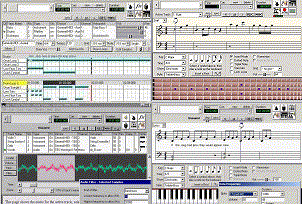
Impress your Music Director Why wait until your conductor goes ape because you haven’t done any singing for three months? There is lots you can do at home to get your voice in trim for the new season. You don’t need a piano, just your original instrument; your voice. There are some very instructive and helpful sites. Notation and scanning software I have copies of Sibelius 7, Photoscore, OMER, Harmony Assistant and the free version of Anvil Studio and my favourite player, MidiPlay. Sibelius will write Scorch files which can be read directly in your Internet browser. Here is a sample which I sequenced for Peter Grimes Some of this software I find very tedious to use, particularly when producing midi files for learning. Most often I key in the notes manually. For music recognition I use SharpEye which makes a very accurate scan of sheet music and interprets it as a midi file, outputs as music xml of niff. It is very quick and has saved me hours of keying in. You can download an evaluation copy here. However, note that you should firstly take the midi into notation software for editing because they are not very usable as they are. Perhaps my favourite all-round notation software is the French program Melody Assistant from Myriad Software. Note input is very easy and the consequent midi files are very accurate. This program will also output html pages which are more functional than those of Scorch. Kay and Peter Bates are registered users of Music Publisher. This software comprises Notation and Music Character Recognition. The method of entering notes is as easy as ABC - literally! If you want the note A, just type A on your keyboard and it will appear on the stave. Thank you both. Try it here. Here is another program which has been recommended. Noteworthy Composer Scriptorium. The contributor told me that he has used this package for many years to prepare electronic versions for fellow choristers. There is a free reader, also a browser plug-in. He has no hesitation in recommending the full version at $39. Give them a try and let me know what you think. Other aids For sheet music, try To develop music theory and Isn’t it wonderful when you arrive at rehearsal to find that everybody is note-perfect? Equally, have you wasted time while the other sections (not yours, of course) do their note-bashing? Click here how to learn them. Learning the notes As a Junior, I was told ,”There’s no point in coming to see me to do your practice”. I discovered that if you didn’t know your notes before the concert, you certainly wouldn’t find them on the day. So learning the notes is fundamental before you can start to make the music. Learning is sometimes very difficult. Almost the worst situation is having to perform a programme comprising perhaps ten works, all from different composers, styles and centuries. Learning a Mass or an Oratorio is helped because you know the format; a Kyrie, Gloria, Benedictus, Agnus Dei and so on. However, your Webmaster has sometimes found it difficult to learn Early Music owing to the lack of ‘geography’. Thomas Tallis’ Spem in Alium is typical. See opposite. A modern way to learn is by listening to midi files (.mid) which can be downloaded from the Internet. Double-clicking on the file will make it play in your default player, usually Microsoft Media Player. |
Choose your media player
However, there are better ways to control what you hear and to see the score at the same time. Consider these
All links to midi sources are being reviewed. Stuck for a mid file? Ask me Midi request If you are using a Mobile there is an excellent App ‘Learn my part’ by Steve Tyler here. If you want to see what it offers and how to use it, go here. If you are on Android try Midi Sheet Music (best of the bunch), Midi Instruments or ACT Piano. None of these is as good as ‘Learn my Part’. Steve Tyler has no plans to write the App for Andoid. Leith Hill Music Festival 2016 1. Click this link to see the learning files for the men’s song, “The Coast of High Barbary” arranged by John Hall. Here is a link to mp3 files in case you prefer them. Click this links below to play the part enhanced version. Right-click to download. They will play on your Mobile. Barbary Tenor 1 2. Click this link to see the learning files for the Ensemble song “Fain Would I Change That Note” by Vaughan Williams. You will need the Myriad Plug-in which you can download by following the instructions on the page. You can trust this plug-in. Leith Hill Music Festival 2015 Learning midi files are available for most of the repertoire. Given sufficient interest, I will post the links to some of them here. So far I have made from scratch a Virtual Singer version of O mistress mine by Eric Thiman. _____________________________________ Leith Hill Music Festival 2014 Learning midi files are available for the following. Duruflé - Requiem, request LHMF 2014 finished but links are left here for other singers wanting the files.
|
Midi sources (continued) Thomas Tallis’ Spem in Alium Go to www.brightonconsort.org.uk I suggest that you use the “Spem in alium in 40 parts” file because I didn’t find that the individual choirs worked very well. If you sit down to consider what Tallis is doing in Spem, you will discover the narrative which moves the whole work along and cements the sections together. Spem is probably his Masterwork. He accepted the challenge of showing how an English composer was more than a match for his Continental rivals. You will find counterpoint, harmony, syncopation all in Spem. If you stand back, you can see the form and why he needed eight choirs and forty voices! There are six elements to the work but there is no break between them. There are Key Points which help tell you where you are, so listen for them. Bars 1 to 25 “Spem in alium numquam habui”. Choirs enter in turn, contrapuntally. Bars 25 to 45 “Praeter in te”. A Key Point is bar 40 “prater in te” where the whole choir comes in with a bang (depending upon your conductor), preceded by a quiet bar. Bars 44 to 65 “qui irasceris, et propitius eris”. A Key Point is bar 59, sops choir 4, where their top G tells you where you are. Bars 65 to 87 “Et omnia peccata hominum in tribulatione dimittis”. Key Point sops top G, bar 79 leads in to choirs 1 and 2 at bar 81. Bars 87 to 108 “Domine Deus, Creator caeli at terrae”. All choirs are more often than not, in harmony. The “Domine Deus” is thrown from one group of choirs to another. Bars 108 to end “respice, humilitatem nostram”. Key Key Point bar 108 where all choirs introduce the final section. Key Point bar 122 where all choirs are in harmony and build up together to the grand finale! Counting the timing is probably the most important thing in Spem; it is not the notes which are difficult. You might not be able to hear clearly, choirs other than your own. If you have a metronome or use that in the AnvilStudio program, you might find dividing each bar into 8 beats will help a lot. Once you’ve learned the notes you should be able to hear the music. I hope you will find this helpful and not just pretentious crap from an amateur musician. Who knows, had I done my practise regularly, I might have made professional. Any queries or comments, please contact John |